[New post] You Eat a Credit Card’s Worth of Plastic Every Week
Fernando Kaskais posted: " What is our hidden consumption of microplastics doing to our health? BY KATHARINE GAMMON Martin Wagner was annoyed that his colleagues were always talking about microplastics in the ocean. It was 2010 and the Great Pacific Garbage Patch had bee" WebInvestigator.KK.org - by F. Kaskais
What is our hidden consumption of microplastics doing to our health?
BY KATHARINE GAMMON
Martin Wagner was annoyed that his colleagues were always talking about microplastics in the ocean. It was 2010 and the Great Pacific Garbage Patch had been headline news. Here was this massive gyre, formed by circular ocean currents in the Pacific Ocean, reportedly brimming with plastic particles, killing sea turtles and seagulls. Wagner, a professor of biology at the Norwegian University of Science and Technology, whose lab focuses on the impact of plastics on human and ecosystem health, felt like scientists were pointing to marine systems as the main repository of these tiny plastic particles. But wouldn't it make sense for them to exist in other systems as well? "It was like, wait a second, it must be in freshwater too," Wagner says today. He set out to search for microplastics elsewhere.
As we know, plastic is omnipresent. Plastic is cheap and easy to make and mold. We use this miracle polymer to store and transport food, make our clothes and cosmetics, cars and boats, detergents and fertilizers, transfuse our blood and floss our teeth. But it also takes between 20 to 500 years to break down a single piece of plastic in a landfill. Those bagged salad containers will be with us for generations to come.
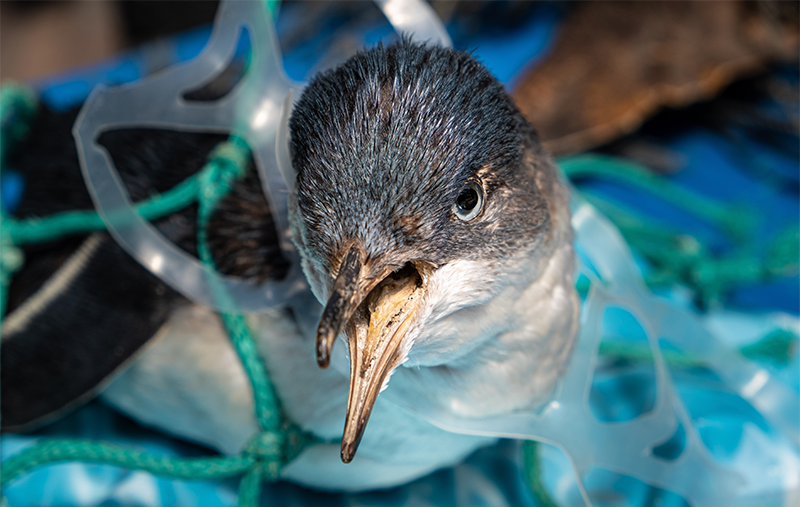
PLASTIC AWAKENING: Plastic trash poisons and kills countless animals every year. Public outcries have led to laudable environmental cleanups. Scientists are now bringing the fallout from microplastics into public awareness. Photo by Greg Brave / Shutterstock.
When it comes to the environment, plastic is a scourge. We've seen the images of marine animals entangled in fishing lines and six-pack holders, beaches piled with plastic items like shopping bags, water bottles, and old toothbrushes. But it's microplastics that increasingly have been the focus of environmentalists and scientists. Microplastics are plastic debris less than five millimeters long. They enter the environment from the natural decomposition of plastic or by being shed by the countless products that contain plastic chemicals.
Microplastics have been found in places as remote as Antarctica1 and the summit of Mount Everest,2 in fish guts, and in honeybees.3 Researchers recently found tiny plastic particles in the lungs of surgical patients, the blood of donors, and the placentas of unborn babies.4 We can breathe in polyethylene from our T-shirts because wastewater plants can't fully filter them out. Microplastics are in our food—carried into the food chain by water or plankton—and in our toothpaste and dental floss.
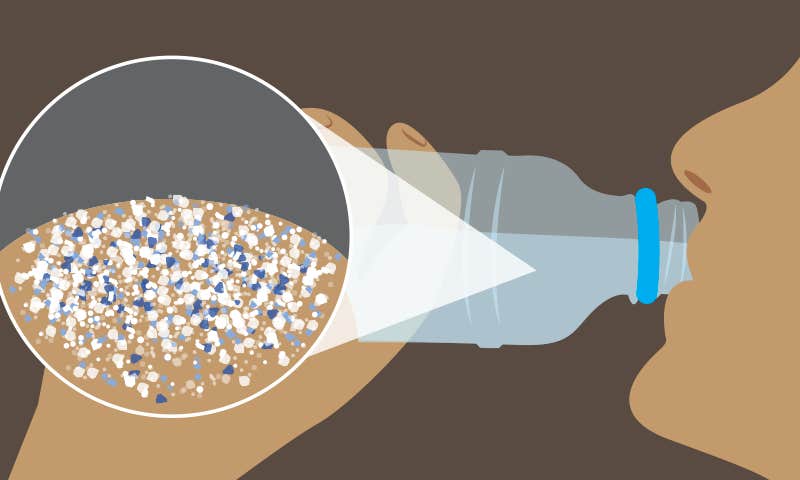
When it comes to eating microplastics, scientists have documented plastic particles in about 40 percent of the human diet, including beer, honey, salt, and seafood. A graduate student in the United Kingdom collected mussels from different parts of the country and predicted that consumers ingest 70 microplastic particles for each 100 grams of mussels.5 Meanwhile, another study showed beer samples had about 28 particles per serving.6 People may be eating as much as a credit card's worth of plastic each week7—or more, because scientists still haven't figured out how to reliably determine microplastic levels in meat, vegetables, grains, or packaged foods, which means we still don't know how much plastic we actually eat.
Yet despite all the new knowledge about microplastics and the even tinier nanoplastics, smaller than a millimeter, that enter the human body through ingestion or inhalation—available in a dizzying array of sizes, colors, and chemical makeups—there remains a gaping question. What exactly does it mean for human health?
We do know for certain that, in principle, plastics in our system can be bad for us. One of the earliest bodies of research on the impact of plastic particles on humans examined the so-called "flock worker's lung," a condition developed by employees of a Rhode Island plant that processed nylon flock, short fibers cut from cables of synthetic monofilaments to produce velvet-like materials used in upholstery, blankets, and clothing.8 The factory had almost no ventilation, and epidemiologists found that workers there had levels of lung cancer that were three times higher than among the people in the area who didn't work in the factory. At first, they suspected the workers were inhaling chemicals, but when they studied the lungs of some of the workers who had died, they found nylon fibers lodged in the lung tissue. "This was significant," says Scott Coffin, a research scientist who leads California's development of regulations for microplastics in drinking water. "It was the late 1990s, and this was the first case that showed microplastics causing cancer in humans."
Scientists have documented plastic particles in about 40 percent of the human diet.
The finding was buried in scientific literature for 15 years, Coffin says, mostly because of terminology: The reports used the term "nylon flocking" instead of "microplastics." Scientists have worked to clarify that kind of distinction...




No comments:
Post a Comment