Fernando Kaskais posted: " "Words for the Heart: A Treasury of Emotions from Classical India," Princeton University Press (August 16, 2022) A new book considers 177 classical Indian terms for emotions—from simmering wrath to six kinds of compassion—to explore how Buddhist texts" WebInvestigator.KK.org - by F. Kaskais
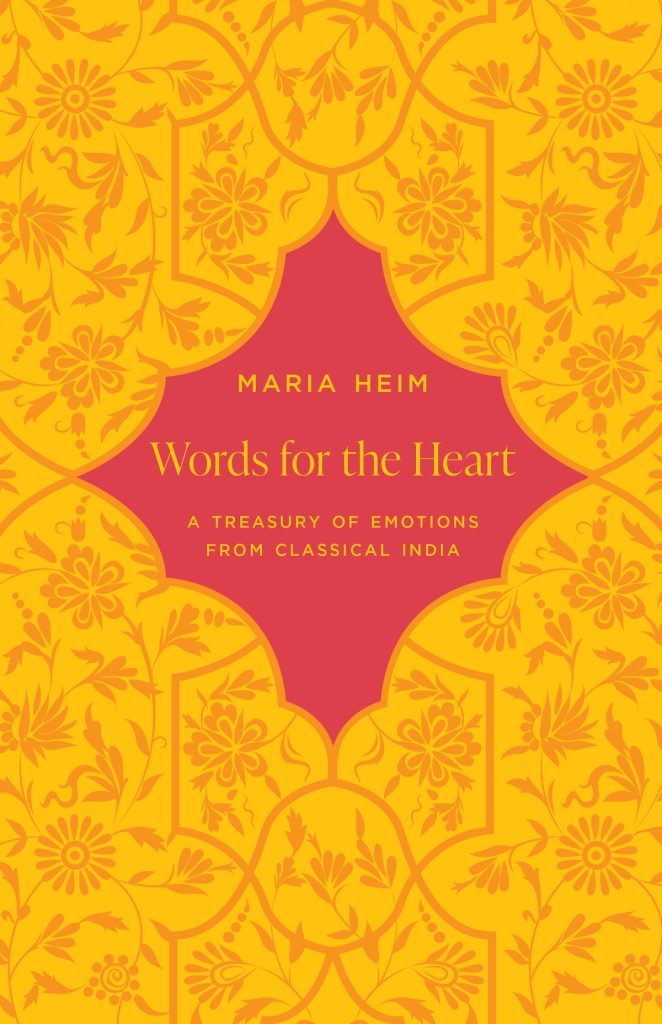
"Words for the Heart: A Treasury of Emotions from Classical India," Princeton University Press (August 16, 2022)
A new book considers 177 classical Indian terms for emotions—from simmering wrath to six kinds of compassion—to explore how Buddhist texts expand our capacity to feel.
In Sanskrit, a kosha, or treasury, is a storehouse of gems. But the term can also refer to a collection of words, poems, and literary passages. Since the fifth century, Indian poets and scholars have compiled treasuries of words to catalog different aspects of human experience, treating each entry like a jewel.
With her new book, Words for the Heart: A Treasury of Emotions from Classical India, scholar Maria Heim continues in this tradition of treasuries, focusing on words used to describe and evoke emotions within classical Indian texts. Drawing from a variety of genres and traditions, Heim presents 177 terms for emotions in three languages: Sanskrit, Pali, and Prakrit. In addition to six different kinds of compassion, Heim's storehouse of emotions includes simmering wrath (manyu); the afterburn of remorse (pashvattapea); too much laughter or hilarity without reason (atihasa); the heart's soft core (hridayamarman); and dispassion and disenchantment with the world (vairagya).
Tricycle sat down with Heim to discuss some of her favorite terms for emotions, how language can shape our capacity to feel, and how classical Indian texts can expand our understanding of what it means to be human.
The book includes 177 words with passages from a variety of languages, genres, and traditions. How did you select which words to include and texts to draw from? First, I gathered up words and passages I had worked on and noticed in the past. Since most of my work has centered on Pali Buddhism and the Abhidhamma, I plunged into Pali lexica and texts for how they list and meticulously describe the phenomena of experience. At the same time, I wanted to cast a very broad net that would embrace all literary works and systems of Sanskrit knowledge—philosophy, medical texts, literature, aesthetic theory, moral and political thought, and so on. So I read everything I could get my hands on. In fact, this was the best part of the project—mining texts for emotion words and how they were used. I read so many wonderful texts and recent translations. It felt like an indulgent privilege.
You mention that you included some entries simply because you found them delightful. What are some of the emotional states that surprised you? I like piti, the blast of joy that reportedly lifted up a young woman in ancient Sri Lanka and flew her through the sky. She had been left behind when her family went to a moonlit mountain shrine of the Buddha because she was heavily pregnant, but as she gazed from her doorway at the mountain and thought of the Buddha, she became so transported that she "soared through the air" to the shrine and wound up getting there before everyone else.
There's also pamojja, the delight of being free of regrets. This experience is conditioned by behaving morally, and when it is present, all sorts of good things cascade into being. From the delight of being free of regrets, one gets a calm body. Then they feel happiness. Then they can concentrate, and with concentration they can see things as they really are. Then they begin to become disenchanted with ordinary things and start to become free.
I especially appreciate the astute characterization of omāna, a kind of conceit of thinking that you are the very worst—what I call "the conceit of self-loathing." There are lists of the different varieties of pride and conceit, and this one is a kind of amplification or projection of self that constructs it as the worst: I am the worst, truly despicable. No really, I am. I must insist. The very worst. Ever.
I also like that the Buddhist texts notice the "zeal of the convert" (ussuka) and regard it with suspicion.
But really, there are a lot of words in the book—177—and these are just a few of the ones that I found fun.
Barrett thus urges that we develop increased emotional granularity, or the ability to notice and name the nuances of experience with a richer emotional lexicon.
You write that the concept of "emotion" is relatively recent. Can you share some of the history of the evolution of the word's meaning? The term emotion as we think of it today is less than 200 years old. Before that, English speakers used passions, sentiments, affections, even the "humors" of Galen, to describe how they felt. These words mean somewhat different things than what we mean today by emotions. In other languages, there is no single word that does exactly what emotion does...




No comments:
Post a Comment