[New post] New Brain Science Shows Us a Sinister Effect of an Idle Mind
Fernando Kaskais posted: " Your mind's regular resting state can be the source of creativity and inspiration—and also a ton of stress and anxiety too. by Alex Tzelni Let's say I wanted to find out what brain regions are responsible for recognizing numbers. I could put pe" WebInvestigator.KK.org - by F. Kaskais
Let's say I wanted to find out what brain regions are responsible for recognizing numbers. I could put people in an fMRI—a kind of brain scan machine—to see which parts of their brain receive blood flow when performing an active task, like hitting a red button when numbers flash on a screen. However, I'd also want to give them a passive task, like fixating on a crosshair floating around the screen, to establish a baseline resting state. That way I could tell the difference between blood flow attributed to recognizing numbers from typical levels of blood flow in the brain.
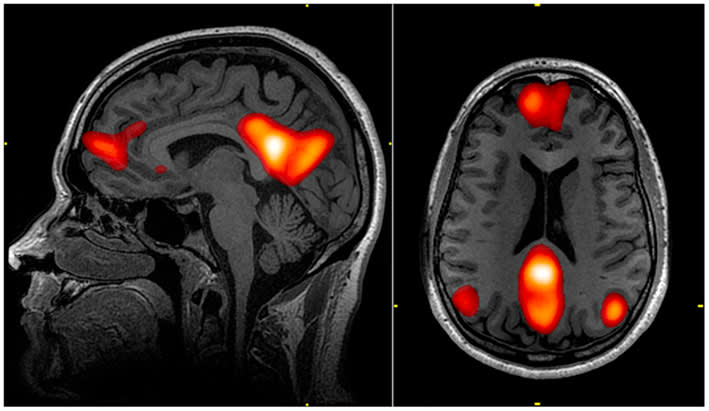
In 2001, Marcus Raichle, a neurologist at Washington University, ran such an experiment—and he noticed an odd consistency in the brain states of participants in his study. The fact that they were exhibiting similar brain states was not unusual by itself. After all, performing specific tasks means similar regions of the brain will be engaged for each person. However, the unusual thing was that the overlap occurred when participants weren't really doing anything at all. While establishing a baseline resting state in the scanner, the participant's brains showed a surprising amount of similarity. It was like discovering that a bunch of random computers all featured a very similar screensaver.
Your brain's default mode network engages when your mind is in its resting state.
This has significant evolutionary implications. Our ability to conceive of ourselves in relation to others and the world allows us to strategize, predict, and plan against the circumstances that may lead to our downfall, whether that is our social status within the tribe or our actual death. In the book Buddha's Brain, psychologist Rick Hanson and neuroscientist Richard Mendius explained how one's ability to construct a self "has been stitched into human DNA by reproductive advantages slowly accumulating across a hundred thousand generations."
Yet our ability to engage in self-absorbed daydreaming has drawbacks. For one, thinking about preserving who we are can manifest as anxiety. A 2011 study by Harvard researchers Matthew Killingsworth and Daniel Gilbert found that people engage in mind wandering about 47 percent of the time, and it's also correlated with unhappiness. The study essentially pinged 2250 people at random throughout the day on their phone and asked them what they were doing, how they were feeling, and whether they were thinking about what they were doing or thinking about something else. Regardless of the activity, people reported being less happy when their minds were wandering than when they were not. Further research found that meditation interrupted the default mode network—as do psychedelics. Meanwhile walking in nature was found to interrupt the kind of depressive rumination that is a hallmark of this network.
All this conspired to give the default mode a bad rap. When left to our own devices, the research suggested, we activate our internal worry monsters, creating a fortified wall between ourselves and our experience.
"By persisting through boredom, resisting the pull of the attention, and seeing where our mind takes us, we can come to some deeper insights."
— Michael Easter
As is often the case when studying the brain, however, other research revealed alternative perspectives. Humanity wouldn't quite have thrived to this extent if not for its unique ability to engage in selfish mentation. Knowing ourselves allows us to know others.
In The War for Kindness, Stanford psychologist Jamil Zaki described the default mode as the "untethered mind"—the state in which our brains take a mental trip to the past or future. "The more you engage the brain's untethering system," wrote Zaki, "the deeper you can go, and the better you understand what other people think or feel."
The journalist Michael Easter described another useful feature of the default mode in The Comfort Crisis. He labeled it "unfocused mode," and explained how the boredom that produces mind wandering is crucial to creativity, a potential survival benefit that prevents us from repeating the same tasks in the same ways all the time. If you've ever had a great idea in the shower, this might ring true.
But all this begs the question: Is the default mode the home of neurotic self-obsession or creative and empathic expression?...




No comments:
Post a Comment