Fernando Kaskais posted: " An anthropologist schooled in spiritual healing offers wisdom for troubled times. BY ANNA BADKHEN Once upon a time, in a thatched spirit hut in the Nigerien village of Tillaberi, the Songhay master sorcerer Adamu Jenitongo told the American ant" WebInvestigator.KK.org - by F. Kaskais
An anthropologist schooled in spiritual healing offers wisdom for troubled times.
BY ANNA BADKHEN
Once upon a time, in a thatched spirit hut in the Nigerien village of Tillaberi, the Songhay master sorcerer Adamu Jenitongo told the American anthropologist Paul Stoller that the bush was angry. "People who speak with two mouths and feel with two hearts anger the spirits of the bush," Adamu Jenitongo said. "When the bush is angry there is not enough rain. When the bush is angry there is too much rain. When the bush is angry locusts eat our crops. When the bush is angry sickness kills our people."
Today, Stoller is a professor of anthropology at West Chester University, a permanent fellow at the Center for Advanced Studies in the Humanities and Social Sciences at the University of Erlangen-Nuremberg, and the author of 15 books. His awards include fellowships from the Guggenheim Foundation and the National Endowment for the Humanities, and the Anders Retzius Gold Medal in Anthropology, given once every three years by the King of Sweden. He is also what the Songhay call a Sohanci benya, a healer who did not inherit his powers but was taught—often a captive or an enslaved person, or, in Stoller's case, a cultural anthropologist from the United States studying the medicinal properties of plants used in Songhay ethnomedicine. Stoller ended up apprenticing with Adamu Jenitongo for 17 years. He explained his teacher's comment to me this way: "His whole thing was that when things are out of kilter, when things are out of balance, when there's a lack of harmony in social relations, then we suffer as human beings."
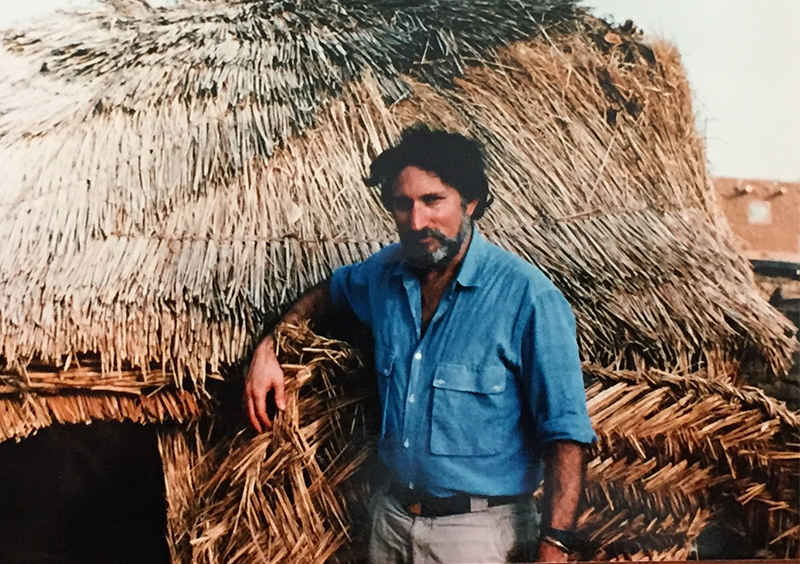
THE STUDENT: A young Paul Stoller outside the spirit hut of his teacher, Adamu Jenitongo, in Tillaberi, Niger. Photo by Idrissa Godji.
Who would deny the lack of harmony in social relations today? It felt like high time to ask Stoller, whose 16th book, Wisdom from the Edge of the Village: Writing Ethnography in Troubled Times, comes out next spring, about what he has learned during his long career, the phenomenon of "spirit possession," and what wisdom we can take from the villages and people he has studied.
You've spent years in Niger and other parts of West Africa, and later in the West African communities in New York. What was the focus of your work in those places?
My early work in Niger focused on how local political actors used competing discourses of Islam and pre-Islamic spirit possession in the arena of village politics. I discovered that in Western Niger many local political actors—avowedly pious Muslims—tapped into pre-Islamic ancestral practices like spirit possession in their play for influence and power. In later work in Niger, I studied the healing properties of medicinal plants, many of which proved to be effective in the treatment of skin disorders, minor infections, gastrointestinal issues, and hepatitis. My teachers provided the names and treatment regimens of these plants and I later linked them to their scientific classifications. The research1 underscored the deep pharmacological knowledge that Songhay healers possessed, knowledge passed down from generation to generation.
In New York City, I focused on economic practices of Nigerien street traders who from the early 1980s to the present have sold a variety of items (African art, perfumes, pomades, baskets, and beaded jewelry). With few resources, they were able to use traditional economic practices, shaped through Islamic principles of trading, to build successful multi-ethnic and multinational networks that provided the wherewithal to build thriving businesses. In short, their past economic and cultural experience created for them an impressive degree of social resilience—a model of social adaptation in troubled times.
I've been observing and thinking about spirit possession for more than 30 years.
What kind of insights have you learned that can help us, or teach us something about what we can do better at this time of global calamity?
Our sorry state of being stems from the notion that we, as masters of the universe, can extract what we want from nature, which, in turn, leads to the "rich" mastering the "poor." We need fundamental transformation. Adamu Jenitongo said that we need to listen to one another. We need to engage in deep listening. We need to be more modest about our capabilities, and we have to be much more respectful of the environment. If we don't make these changes, our future will be exponentially worse. Listening is not just hearing what other people say. It's tuning in to the other person. Such listening is a multi-sensorial experience. It does take a little bit of practice. In the end, these simple interpersonal practices can immeasurably enrich your life-in-the-world. In my experience, the results are transformative...





No comments:
Post a Comment