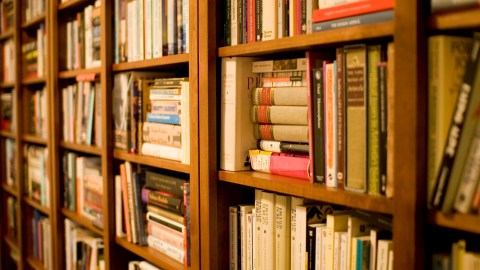
(Photo from Wikimedia)
Or, how I learned to stop worrying and love my tsundoku.
KEY TAKEAWAYS
- Many readers buy books with every intention of reading them only to let them linger on the shelf.
- Statistician Nassim Nicholas Taleb believes surrounding ourselves with unread books enriches our lives as they remind us of all we don't know.
- The Japanese call this practice tsundoku, and it may provide lasting benefits.
By Kevin Dickinson
I love books. If I go to the bookstore to check a price, I walk out with three books I probably didn't know existed beforehand. I buy second-hand books by the bagful at the Friends of the Library sale, while explaining to my wife that it's for a good cause. Even the smell of books grips me, that faint aroma of earthy vanilla that wafts up at you when you flip a page.
The problem is that my book-buying habit outpaces my ability to read them. This leads to FOMO and occasional pangs of guilt over the unread volumes spilling across my shelves. Sound familiar?
But it's possible this guilt is entirely misplaced. According to statistician Nassim Nicholas Taleb, these unread volumes represent what he calls an "antilibrary," and he believes our antilibraries aren't signs of intellectual failings. Quite the opposite.
LIVING WITH AN ANTILIBRARY
Taleb laid out the concept of the antilibrary in his best-selling bookThe Black Swan: The Impact of the Highly Improbable. He starts with a discussion of the prolific author and scholar Umberto Eco, whose personal library housed a staggering 30,000 books.
When Eco hosted visitors, many would marvel at the size of his library and assumed it represented the host's knowledge — which, make no mistake, was expansive. But a few savvy visitors realized the truth: Eco's library wasn't voluminous because he had read so much; it was voluminous because he desired to read so much more.
Eco stated as much. Doing a back-of-the-envelope calculation, he found he could only read about 25,200 books if he read one book a day, every day, between the ages of ten and eighty. A "trifle," he laments, compared to the million books available at any good library.
Drawing from Eco's example, Taleb deduces:
Read books are far less valuable than unread ones. [Your] library should contain as much of what you do not know as your financial means, mortgage rates, and the currently tight real-estate market allows you to put there. You will accumulate more knowledge and more books as you grow older, and the growing number of unread books on the shelves will look at you menacingly. Indeed, the more you know, the larger the rows of unread books. Let us call this collection of unread books an antilibrary. [Emphasis original]
Maria Popova, whose post at Brain Pickings summarizes Taleb's argument beautifully, notes that our tendency is to overestimate the value of what we know, while underestimating the value of what we don't know. Taleb's antilibrary flips this tendency on its head.
The antilibrary's value stems from how it challenges our self-estimation by providing a constant, niggling reminder of all we don't know. The titles lining my own home remind me that I know little to nothing about cryptography, the evolution of feathers, Italian folklore, illicit drug use in the Third Reich, and whatever entomophagy is. (Don't spoil it; I want to be surprised.)
"We tend to treat our knowledge as personal property to be protected and defended," Taleb writes. "It is an ornament that allows us to rise in the pecking order. So this tendency to offend Eco's library sensibility by focusing on the known is a human bias that extends to our mental operations."
These selves of unexplored ideas propel us to continue reading, continue learning, and never be comfortable that we know enough. Jessica Stillman calls this realization intellectual humility.
People who lack this intellectual humility — those without a yearning to acquire new books or visit their local library — may enjoy a sense of pride at having conquered their personal collection, but such a library provides all the use of a wall-mounted trophy. It becomes an "ego-booting appendage" for decoration alone. Not a living, growing resource we can learn from until we are 80 — and, if we are lucky, a few years beyond.
TSUNDOKU
I love Taleb's concept, but I must admit I find the label "antilibrary" a bit lacking. For me, it sounds like a plot device in a knockoff Dan Brown novel — "Quick! We have to stop the Illuminati before they use the antilibrary to erase all the books in existence."
Writing for the New York Times, Kevin Mims also doesn't care for Taleb's label. Thankfully, his objection is a bit more practical: "I don't really like Taleb's term 'antilibrary.' A library is a collection of books, many of which remain unread for long periods of time. I don't see how that differs from an antilibrary."...
more...
https://bigthink.com/neuropsych/do-i-own-too-many-books/

F. Kaskais Web Guru


No comments:
Post a Comment