Forgetting and misremembering are the building blocks of creativity and imagination.
BY CODY KOMMERS
In 1942, the Argentine writer Jorge Luis Borges published a short story called "Funes the Memorious." The unnamed narrator recounts a story from his memory, which centers on a Uruguayan man named Ireneo Funes. The narrator learns Funes has fallen off his horse, hitting his head and leaving him housebound. Not long after, Funes contacts the narrator, asking to borrow some of his books in Latin, which is the narrator's specialty. He gives Funes a selection of his most difficult Latin texts, ones that he has trouble making sense of himself.
A few days later, when the narrator goes to collect his books, he finds that Funes has memorized, in just a matter of days, long and complicated passages in Latin, despite no prior knowledge of the language. Funes tells the narrator that, ever since the accident, his memory has changed. He no longer can forget. As Funes describes it, his experience is now of one "intolerable richness and sharpness." Whereas the rest of us look out and see a tree here, a group of people there, Funes sees the pixel-level information, frame by frame. Because he retains the full clarity of these scenes in memory, his memories have indistinguishable precision when compared to his present reality.
Funes details the consequences of his now infallible memory. Sleep eludes him and he finds basic aspects of language perplexing. It is difficult for him to comprehend that the word dog "embraces so many unlike individuals of diverse size and form." And, "his own face in the mirror, his own hands, surprised him every time he saw them." Even though Funes had learned Latin and several other languages with little effort, the narrator suspects Funes "was not very capable of thought. To think is to forget differences, generalize, make abstractions. In the teeming world of Funes, there were only details, almost immediate in their presence." In the morning, the narrator leaves for Buenos Aires. He never sees Funes again.
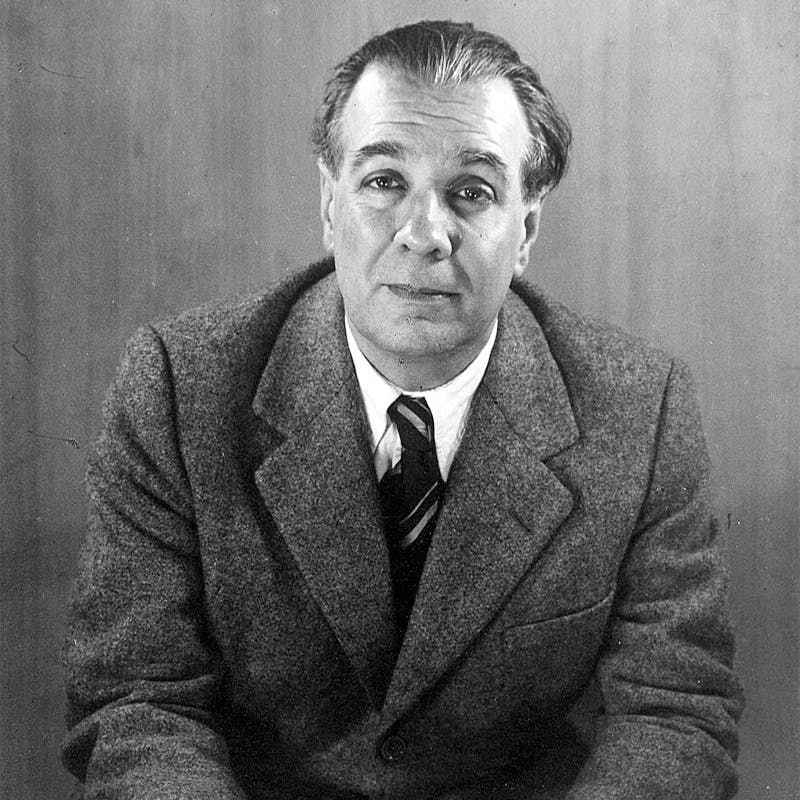
I GO BACK: Jorge Luis Borges, the celebrated Argentine novelist, cultivated a powerful memory from a young age to compensate for a condition that caused him to lose his sight later in life. He memorized many of his favorite texts. Photo credit: Wikimedia Commons.
Borges, who died in 1986, had a remarkable memory himself. The Argentine writer memorized many texts from a young age, knowing that he would eventually lose his eyesight and his ability to read due to a congenital condition. Writer and neuroscientist Rodrigo Quian Quiroga learned these details about Borges in 2009, when he visited Borges' widow María Kodama in Buenos Aires. Quiroga, who recounts the visit for a piece in Nature, also toured Borges' private library, which revealed the author's lifelong interest in psychology and neurology. In "Funes the Memorious," Borges anticipated what modern neuroscience has evidenced. We make our way through the world precisely because we forget, generalize, and make abstractions. The act of memory is an act of imagination.
In 1985, the Estonian-Canadian psychologist Endel Tulving, with the help of his American student Daniel Schacter, reported a case study of an amnesiac patient named N.N., who had a severe memory impairment.1 What interested Tulving about the patient was that while some aspects of the man's memory were impaired, other aspects seemed to work just like anyone else's.
N.N. was perfectly able to memorize a series of random digits, what cognitive psychologists call semantic memory—the ability to recall facts, dates, names, numbers, and other abstract information. The problem was N.N.'s episodic memory. He was unable to bring to mind personal experiences from his life. Tulving wrote that "N.N.'s knowledge of his own past seems to have the same impersonal experiential quality as his knowledge of the rest of the world." It was about as intimate as his knowledge of, say, Thomas Jefferson's life—a collection of abstract facts. He couldn't recall the specifics of any events he'd experienced himself, not a single birthday party, vacation, or social encounter.
Memory provides the building blocks for mental time travel.
The thrust of Tulving's report centered around this dissociation between semantic and episodic memory, how it was possible to have one without the other. But there was another observation Tulving reported, though he was unsure what to make of it. Not only was N.N. incapable of remembering past personal events, he couldn't imagine future ones either. In one conversation with N.N., Tulving began with the question, "What will you be doing tomorrow?" After a pause, N.N. replied: "I don't know."
"Do you remember the question?" asked Tulving.
"About what I'll be doing tomorrow?" said N.N.
"Yes," said Tulving. "How would you describe your state of mind when you try to think about it?"
"Blank, I guess," N.N. responded.
When pressed by Tulving, N.N. described his attempts to imagine his own future as "like being asleep." His effort to imagine a personal future felt as empty as his effort to remember his personal past: "It's like swimming in the middle of a lake. There's nothing there to hold you up or do anything with."...
more...
Faulty Memory Is a Feature, Not a Bug

F. Kaskais Web Guru


No comments:
Post a Comment