Top: Scientists and students participate in the 2019 March for Science at Rajabazar Science College, Kolkata, West Bengal, India. Visual: Avishek Das/SOPA Images/LightRocket via Getty Images
In recent years, falsehoods have spread to institutions, where the next generation of scientists are being educated.
BY ARBAB ALI & NADEEM SARWAR
IN OCT. 2022, India's Ministry of Science and Technology, in collaboration with other ministries and departments, announced that it would host a four-day conference called "Akash For Life" at a university in the northern Indian city of Dehradun.
"Akash" translates to "sky" or "spirit" in Hindi, and refers to one of five universal elements according to Hinduism. The event, according to its organizers, would integrate such traditional concepts into an academic sphere, and seek to "educate the youth of India to the wisdom of ancient science along with modern scientific advancements."
But no sooner than the event was announced, it stirred furor in the Indian scientific community.
In a statement issued later that month, the Karnataka chapter of the nonprofit India March for Science wrote, "We reject the concept of Panchabhootas" — referring to the Hindu concept of the five elements. "The sky, earth, water are not elements. Such concepts have been deleted from science books a long time back."
The West Bengal chapter was similarly clear in its disapproval: "Any attempt to belittle or trivialize humanity's quest for knowledge through the scientific method has to be debunked and thoroughly rejected."
The Ministry of Science and Technology did not respond to multiple requests for comment from Undark.
The "Akash" conference was just one of the latest events in India to face charges of pseudoscience as academics grow concerned about the country's rise of conspiracies and falsehoods. Journalist Ruchi Kumar reported on this phenomenon for Undark in 2018, but experts say such discourse has only picked up in pace — and increasingly spread to institutions, where the next generation of scientists are being educated.
Aniket Sule, an associate professor at the Tata Institute of Fundamental Research in Mumbai, noted that while fringe voices can be few and far between, they are still given prominence at conferences and meetings, which paints a wrong picture for the entire faculty.
"Now, what has happened is that these fringe right-wing sympathizers have been given prominence," said Sule. "Even if, for example, out of a hundred people, if there is one right-wing sympathizer, then that one person would be called to all events."
MANY EXPERTS HAVE tied the rise of pseudoscience in India to the Bharatiya Janata Party, a right-wing political party that came to power in 2014, when Prime Minister Narendra Modi was elected. Members of the party have repeatedly amplified scientific falsehoods — for instance, that cow urine can cure cancer, or that ancient Indians invented the internet.
"It is clear that the government is propagating this sort of pseudoscience," said Soumitro Banerjee, an engineering professor at the Indian Institute of Science Education and Research in Kolkata.
Such claims often tout the superiority of traditional knowledge over modern science and cite ancient Hindu texts as evidence. In recent years, they have leapt over to academic circles.
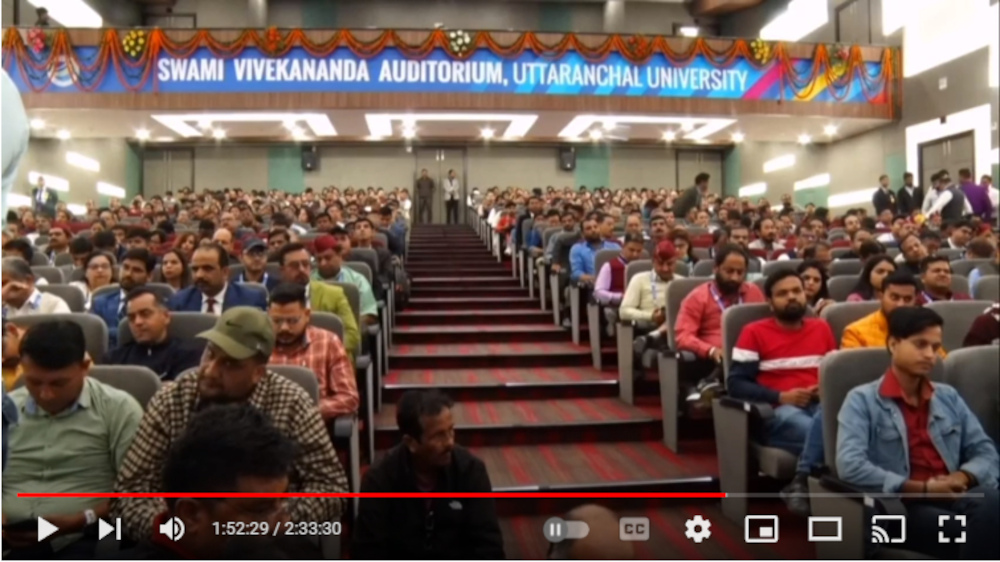
A screenshot of the audience in attendance at "Akash For Life" in the fall of 2022. Visual: Uttaranchal University/YouTube
In 2019, for example, G. Nageswara Rao, then vice chancellor of Andhra University, said that the Kauravas — who appear in the Hindu epic Mahabharata — were born of "stem cell and test tube technology."
More recently, news came out that Laxmidhar Behera, director of the Indian Institute of Technology Mandi, once claimed to have performed an exorcism with holy chants. When asked about the experience, Behera later told the newspaper The Indian Express, "Ghosts exist, yes."
Scientific falsehoods have not only been espoused by academics, but have also made their way into course teachings.
In 2020, the Indian Institute of Technology Indore introduced a class to impart mathematical and scientific knowledge from ancient texts in the Sanskrit language. And in February of this year, IIT Kanpur — one of the country's most elite universities — invited Rajiv Malhotra for a guest lecture. In the past, Malhotra cited an satirical article in denying the Greek civilization's existence and touted the spiritual concept of the "third eye" as a substitute for medical diagnosis.
The same month, a group of scientists and researchers criticized the National Commission for Indian System of Medicine — the regulatory body governing public medical institutions' policies — for introducing medical astrology as an elective in the Bachelor of Ayurvedic Medicine and Surgery program, which is offered at hundreds of institutions in India. The course material offers remedies in the form of mantras, amulets with protective powers, rituals, and counseling based on astrological calculations.
Aniket Sule noted that while fringe voices can be few and far between, they are still given prominence at conferences and meetings.
Ayurveda is a traditional system of Indian medicine that takes a natural approach to healing. Practitioners believe that diseases happen due to an imbalance in a person's consciousness, and therefore, rely on a healing system that involves herbs, exercises, and meditation...
more...
Amid Indian Nationalism, Pseudoscience Seeps Into Academia

F. Kaskais Web Guru



No comments:
Post a Comment