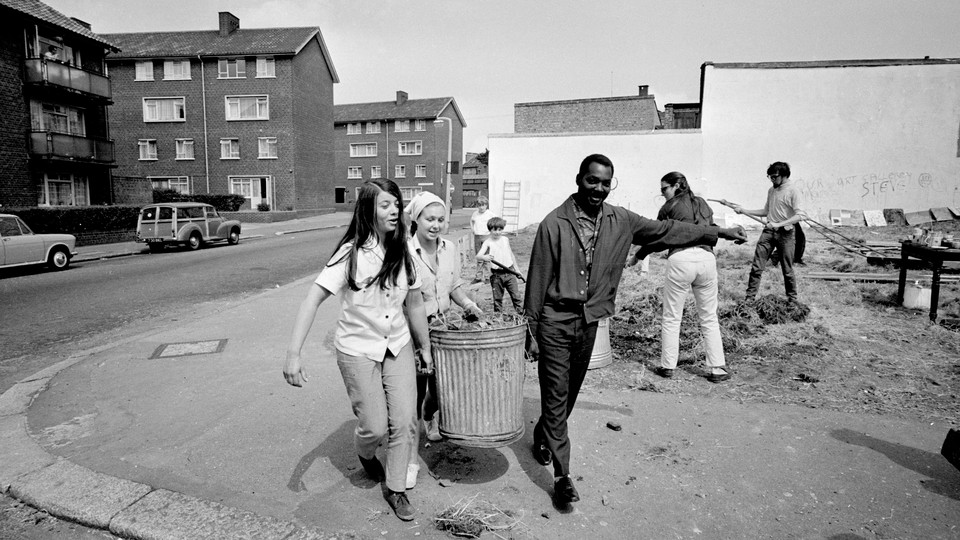
Len Trievnor / Hulton Archive / Getty
Don't succumb. It's a psychological illusion.
By Hanna Rosin
I have a long-running argument with my brother. He insists that his children, who are growing up in New York City right now, are a lot less safe than we were as kids in the same neighborhood. I happen to know this is absurd, and I've tried for many years to convince him. I've shown him news reports, crime statistics. Once I even downloaded an FBI report showing without a doubt that New York was much more dangerous 30 years ago. But he is unmoved. He remembers our childhood as gentler, safer. And I have to admit—there are moments when I walk around my old neighborhood and see visions of the mailman tipping his hat to my 10-year-old self, and the neighbors smiling as I made my way home to dinner.
Why do so many of us have this feeling that when we were younger, people were nicer and more moral, and took care of one another better? An experimental psychologist named Adam Mastroianni had also been wondering about this persistent conviction and did a systematic study of the phenomenon recently published in Nature.
Mastroianni documents that this hazy memory is shared by many different demographics, and felt quite strongly. He explains how the illusion works and why it has such a hold on us. And most important, he explains how it can distort not just our personal relationships but our culture and politics. In this episode of Radio Atlantic, I talk with Mastroianni and staff writer Julie Beck about the illusion of moral decline, and why it persists so strongly.
Whenever politicians or aspiring politicians make the claim that, you know, "Things used to be better, put me in charge and I'll make them better again"—that's a very old thing that we've heard many times. And it resonates with us, perhaps because we are primed to believe it, even when it's not true.
The following episode transcript has been edited lightly for clarity:
Hanna Rosin: So, Julie, you know—even though I get annoyed when other people say people used to be nicer, I kind of think I might feel that way too.
If I have a vision of my childhood and I'm walking down the street from the playground, I imagine all my neighbors saying, "Hi, little Hanna." [Laughter.] And the mailman coming by, you know, and tipping his hat at me, and the old man walking his dog.
And, you know, I have no idea if this memory is accurate, but I definitely have that feeling that people were nicer.
Julie Beck: Did you grow up in Mister Rogers' Neighborhood? Or what was it?
Rosin: No; I actually grew up in Queens, New York. So it's probably, certainly not true. [Laughter.]
This is Radio Atlantic. I'm Hanna Rosin. I invited my colleague Julie Beck on to talk about something that's always really bothered me. It's when people talk about how things are so much worse today than they were in the past.
And they say things like "Neighbors used to be nicer, and everyone used to smile at you and help you out." And sometimes it's just grandpa chatter and you can pretty much ignore it. And then other times it turns into this "back when men were men and women were women"–type thing, which is more annoying.
Beck: There's a benign wish to, like, tip your hat to the mailman. And then there's a "Oh, we need to bring back the social order of the 1950s." And then you're like, "Whoa, how did we end up here?"
Julie analyzes psychological research and social trends, and she's also the host of another Atlantic podcast, How to Talk to People.
And she's here to help me understand this very interesting research that just emerged about this strong conviction people have that everything has gotten worse.
Adam Mastroianni: So my whole life, I've heard people say things like, "You used to be able to keep your doors unlocked at night," or "You can't trust someone's word anymore."
And I always chafed at those kinds of statements. So part of it was wanting to prove everybody wrong. But part of it, too, was like, Well, if they're right, this is a big problem. And that's kind of where we got started.
Rosin: That is Adam Mastroianni. He recently published a paper in Nature called "The Illusion of Moral Decline." Adam is a psychologist, and he's the author of the science blog Experimental History. And he spent a decade systematically studying why we feel things were better in the past … and what it means.
Mastroianni: I think my first year of graduate school was when Trump got elected. And so obviously it was a moment of "Make America Great Again" being sort of the vibe of the day...
more...
https://www.theatlantic.com/podcasts/archive/2023/07/are-you-plagued-by-the-feeling-that-everyone-used-to-be-nicer/674838/

F. Kaskais Web Guru



No comments:
Post a Comment