Sam Illingworth posted: "Beneath twisting mangrove roots, translucent phantoms glide – hypnotic, steady beats to navigate these woody webs. With pulsing bells they gently weave, each sting and strand a tool to dowse, and twist, and bend. Ghostly, they float through t" ScienceBlog.com
Beneath twisting mangrove roots, translucent phantoms glide – hypnotic, steady beats to navigate these woody webs. With pulsing bells they gently weave, each sting and strand a tool to dowse, and twist, and bend. Ghostly, they float through tangled paths, trailing limbs like thoughts: seeking, testing, pacing. Flickers through the shadows, silent creatures seeking secret patterns in their thoughts drawn by sight, and sound, and sense to float, and flow, and dance.
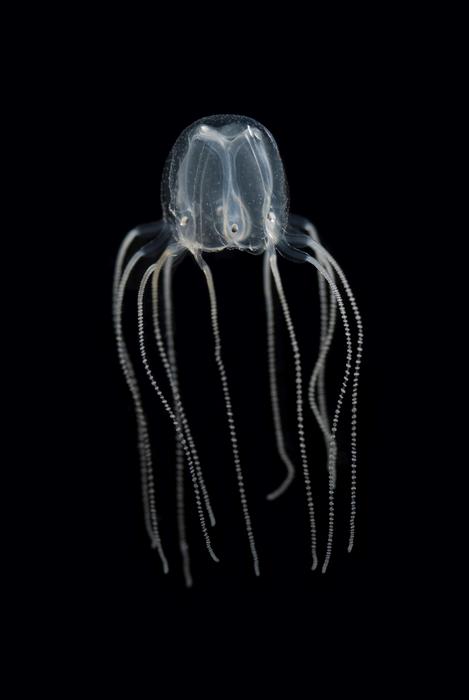
A Caribbean box jellyfish. Black dots embedded low on the bell are the animal's visual sensory and learning centre called rhopalia (Image Credit: Jan Bielecki).
This poem is inspired by recent research, which has found that jellyfish can learn from past experiences.
Box jellyfish are captivating marine creatures that inhabit various oceanic regions around the globe. These gelatinous animals, with their delicate, translucent bodies, are often noted for their potent venom. However, there's more to them than just their sting. The Tripedalia cystophora, a specific type of box jellyfish, has a remarkable ability: it can skilfully manoeuvre through the intricate maze of mangrove roots, avoiding any obstacles that come its way. This skill isn't just random luck; it's a unique protective behaviour that this jellyfish has developed. While navigating the challenging environment of mangroves, this ability is crucial for the jellyfish to find food and protect itself from potential threats.
Researchers have now conducted a study to understand if these jellyfish can learn from their experiences, similar to how we learn from ours. Through a series of tests, they discovered that the jellyfish do indeed have the capability to learn using a process called 'operant conditioning'. This is surprising because, unlike us, these jellyfish do not have a conventional brain. The findings challenge our understanding of learning, suggesting that even simple creatures without complex brains can learn from their environment. This raises interesting questions about the nature of learning in the animal kingdom.





No comments:
Post a Comment