Top: A southern yellow-billed hornbill in South Africa. The birds have experienced a dramatic drop in reproductive success due to slightly higher average daytime temperatures. Visual: Annick Vanderschelden Photography/Moment Open via Getty Images
Adam Welz's "The End of Eden" is a powerful warning about "the intimate ecological breakdowns" imperiling life on Earth.
BY ERICA GOODE
THERE IS A MOMENT IN Verdi's Requiem when the hushed, somber tones that end the first movement give way to the lacerating chaos of the second. The Verdi scholar Julian Budden once described this second movement, the Dies Irae (literally, "day of wrath"), as "an unearthly storm," with its "tutti thunderclaps" and swirling scales. It is meant to awaken listeners from their easy complacency, to remind them that what they should fear is not only death but something much larger and scarier, a looming judgment day that, as the chorus sings, in Latin, "will dissolve the world in ashes."
Adam Welz's book, "The End of Eden: Wild Nature in the Age of Climate Breakdown," delivers a similarly powerful warning, although far more quietly. An accretion of detail, a telling of story after story — the slow death of a tick-infested moose in Maine; the bleak fate of sunflower sea stars in the waters along the North America's West Coast; the killing of hemlock trees by the juice-sucking hemlock wooly adelgid — at some point becomes a narrative of horror and unbearable sadness, as the enormity of what is happening sinks in for the reader. It's not just the loss of a bird here, a tree there, but the devastation of all life on the planet.
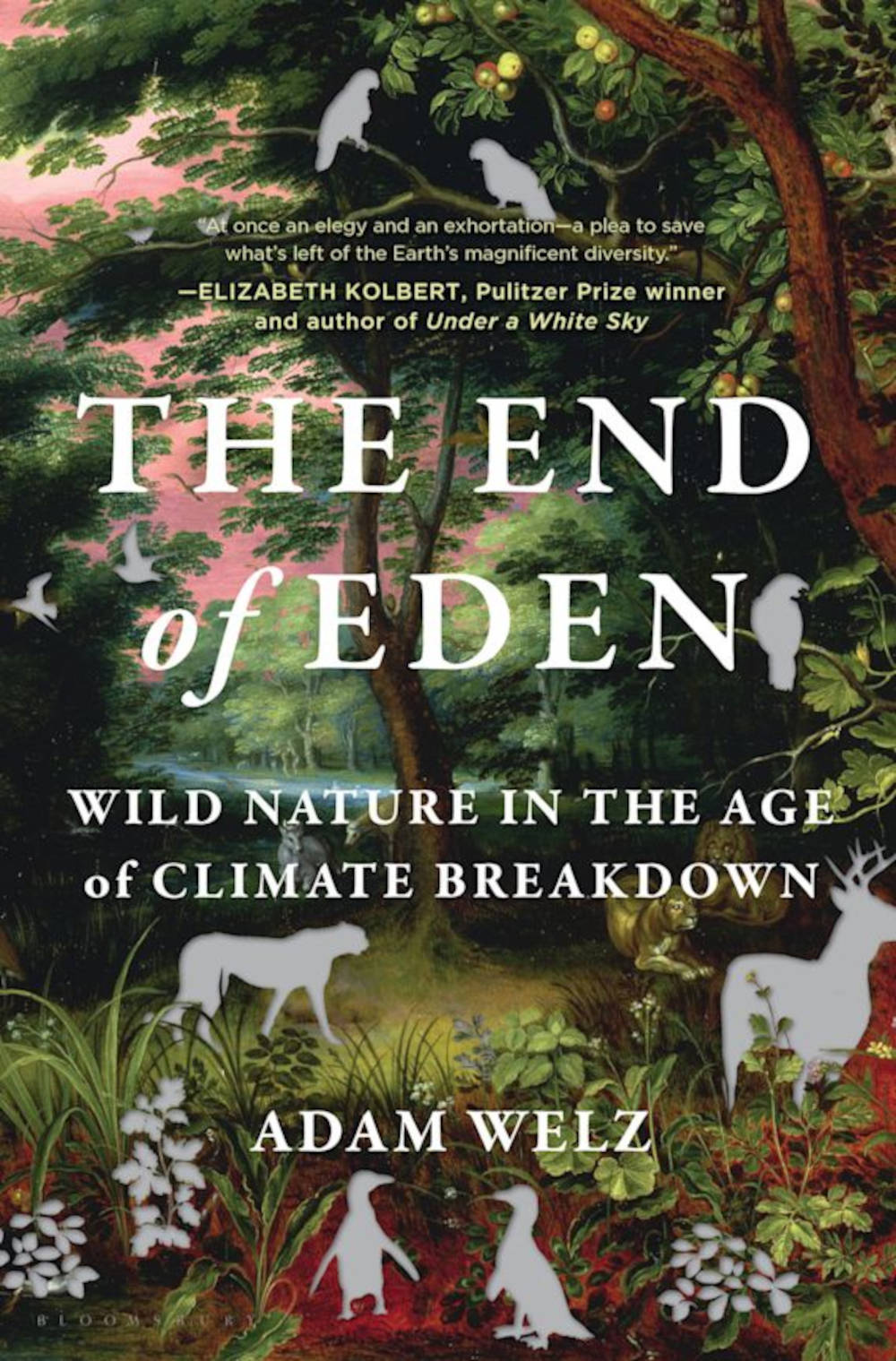
BOOK REVIEW — "The End of Eden: Wild Nature in the Age of Climate Breakdown," by Adam Welz (Bloomsbury Publishing, 288 pages).
The apocalypse that Welz is writing about, of course, is of human making. It's the result of what he refers to as climate breakdown— a term he prefers to use over climate change, which, he points out, carries an implication of reversibility.
As a subject, it is hardly virgin territory. Dozens, if not hundreds, of books have already been written about the destructive activities of Earth's human inhabitants — the pouring of billions of tons of greenhouse gasses into the atmosphere every year, and the decimation of untold acres of wilderness through urbanization, industrial farming, deforestation and other exploitive practices. Most focus on the effects of climate change that are dramatic enough to drive media coverage and that directly affect people's lives: extreme weather events like hurricanes and floods, megadroughts, wildfires that rage out of control.
Welz's aim is different. Climate impacts writ large are "wreaking havoc on nature," he writes in the introduction. "But species and ecosystems are also being eroded and rearranged more subtly as local microclimates shift and change, forcing smaller, less-noticed life forms to evolve, move away, or wither into extinction."
"These intimate ecological breakups and breakdowns," he continues, "are of no less consequence than the so-called natural disasters that generate dramatic headlines, and they're happening all around us."
Weaving these subtle and intimate changes into a riveting read might seem a tough challenge. Where are the flooded houses? The derailed lives of wildfire victims? At the very least, where are the polar bears? And in fact, there are stretches in the book that are densely technical: a lengthy explanation of energy exchange in the first chapter, for example.
But Welz, an environmental writer, nature conservation consultant, and filmmaker, is a deft writer and a gifted natural historian. The depth of his scientific knowledge — he is equally at home writing about the light receptors in the cheetah's retina, the hydrocarbons that are an essential component of plant cell walls, or the role of the enzyme aromatase in the reproductive cycle of the green turtle — enables him to slowly compound individual catastrophes into a massive tragic whole.
"These intimate ecological breakups and breakdowns are of no less consequence than the so-called natural disasters that generate dramatic headlines, and they're happening all around us."
He does this by telling the stories not of single endangered species but of specific ecosystems — their history, the cascading changes in habitat, wildlife, and temperature that have shaped and damaged them, and the factors that have come to threaten the survival of the plants and animals that support them.
The book's chapters leap from biome to biome, from Namibia and Australia to the Alaskan Arctic and the pine barrens of New Jersey — places where climate change and the loss or destruction of habitat are tilting the balance of nature.
There are detours: a discussion of combustion, or photosynthesis, or the "many remarkable attributes" of water, for example, or a brief recounting of the life of Joseph Grinnell, who at the beginning of the 20th century began a survey of the birds and small mammals of California and was involved in the founding of the Museum of Vertebrate Zoology at the University of California, Berkeley. These departures from narrative are not wasted space. They offer scientific explanation or historical context that helps readers understand, with precision, why the disappearance of species, the increase in wildfires and hurricanes, and other human-driven changes, are so important...
more...
https://undark.org/2023/12/01/book-review-end-of-eden/

F. Kaskais Web Guru



No comments:
Post a Comment