Coming into this semester, I had a limited understanding of the skills that would be required to conduct my own research project. In addition, I was unsure of how the research process would look like for a computational biology field. Since I was not going through the traditional process of coming up with a research question, hypothesis, and collecting data to make a conclusion about my hypothesis, I went into this experience without having an idea of what it would be like. I have learned that the research process is dynamic and comes in many shapes and forms. I have been working on gaining more insight into the structure and function of beta galactosidase protein. This involves finding specific amino acids that are involved in relevant interactions with its substrate, lactose and developing 3D printed models that can be used in biology classrooms. I have created different models depending on specific instructional goals such as the ribbon and surface model to highlight unique features of the protein. I have also created a model to visualize the assembly of beta galactosidase into its tetrameric unit where two dimers come together to form each active site. In addition, I have been working on creating instructional figures depicting the proteins involved in the lac operon (a string of genes that control the transport and metabolism of lactose in bacterial cells) that can be used in biology classrooms to supplement lectures.
Through making 3D printed models of key proteins in the lac operon, I have learned how to use the critical thinking skills required to do research in an untraditional format. One particular skill that I have learned to utilize is working through solving problems. In any field of research, problem-solving is essential. In my research, I ran into a variety of problems when trying to develop my 3D models, particularly when trying to optimize the software program (UCSF Chimera) to show what I wanted it to show. I had to work through multiple errors in the software program to get it to run through my commands. In addition, I realized that it was vital to learn how to filter out what is important from what is not in order to achieve your research goal and present your information in the most succinct way. There were many details in the proteins regarding amino acid interactions that I had to sort through and determine whether they would be useful for my project.
In the future, I hope to expand my work by covering more proteins involved in the lac operon. There are a multitude of proteins involved in the functioning and regulation of the lac operon and I was not able to investigate them all within the scope of this project. In addition, I hope to expand our current library of 3D models by focusing on proteins from other key biochemical pathways such as the TRP operon ( a string of genes that control the transport and metabolism of amino acid, tryptophan in bacterial cells). CURF has given me a great introduction to conducting my own research project and I hope to expand on this experience by conducting more research projects in the future to work towards a career in healthcare research.
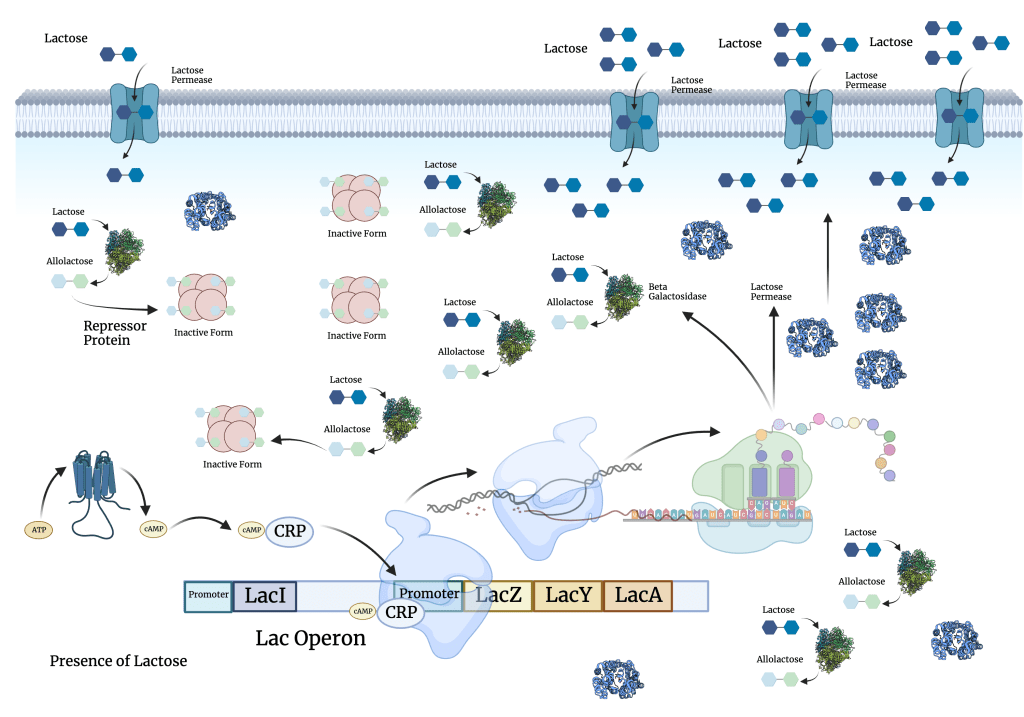
This figure is a visual representation of the lac operon, this depicts the transcription and translation of key proteins involved in the transport and metabolism of lactose in a bacterial cell. This figure specifically shows the progression in the regulation of lactose metabolism as the concentration of lactose increases from left (low lactose concentration) to right (high lactose concentration).



No comments:
Post a Comment