Uday Devgan MD posted: " For nearly all of my cataract surgery cases, I prefer topical anesthesia which is then augmented with mild intra-venous sedation and intra-cameral agents. For the topical anesthesia we have traditionally relied on tetracaine solution for cataract sur" Cataract Coach™
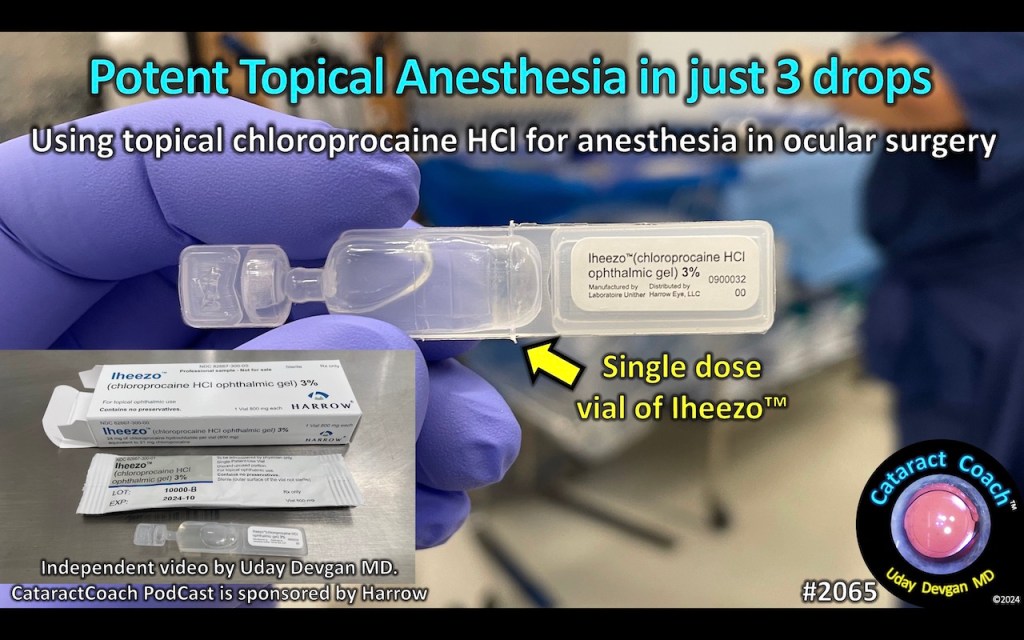
For nearly all of my cataract surgery cases, I prefer topical anesthesia which is then augmented with mild intra-venous sedation and intra-cameral agents. For the topical anesthesia we have traditionally relied on tetracaine solution for cataract surgery and proparacaine solution for LASIK / PRK surgery. These agents work well but they have limitations particularly in terms on contact time with the ocular surface. Using a topical anesthetic with a gel formulation can keep the anesthetic agent on the ocular surface longer and also prevent corneal dryness due to lack of blinking from the effect of anesthesia. Recently I have been using preservative-free chloroprocaine HCl 3% gel (trade name Iheezo from Harrow) which gives potent ocular surface anesthesia in just 3 drops. I instill one drop in the pre-op area and then two more drops once the patient is in the operating room and before the start of surgery. Onset of action is about 40 seconds and the duration of effect is about 15 to 20 minutes. The level of ocular surface anesthesia is so good that I can perform conjunctival and scleral incisions (including electro-cautery and suturing) without additional local anesthetics.






No comments:
Post a Comment