Testing at the Duke University Parapsychology Laboratory, undated. Courtesy Duke University Photo Archives/David M. Rubenstein Library
For the entire 20th century, it had felt like telepathy was just around the corner. Why is that especially true now?
Roger Luckhurst is the Geoffrey Tilloston Chair of Nineteenth-Century Studies at Birkbeck College, University of London. He is the author of Gothic: An Illustrated History (2021) and Graveyards: A History of Living with the Dead (forthcoming, 2025).
In 2016, Elon Musk launched Neuralink with the aim of manufacturing an electronic implant in the brain that could link it directly to the computer network. Musk's company was joining the race to build brain-computer interface (BCI) technology, which involved Meta, Google and a host of neurology start-ups funded by Silicon Valley entrepreneurs. Musk's focus was, for a time, diverted by market-share and software problems with Tesla and by his well-publicised buyout of Twitter, but in May 2023, it was announced that Neuralink had received approval to proceed from controversial animal to in-human trials with brain implants. In early 2024, there was extensive coverage of the implantation of a chip into the brain of a quadriplegic patient, Noland Arbaugh, who, soon after the operation, could play chess and his favourite video game just by focusing his thoughts on moving a computer cursor.
Musk named the implant, which embeds 1,024 small electrodes into the brain to read its neural signals, Telepathy. At launch, he explained that Neuralink's main aim was to create an interface to realise 'consensual telepathy'. Seven years later, the press obligingly headlined the livestream of Arbaugh playing chess with his mind as actively 'demonstrating telepathy' (although the later paragraphs of the news stories all tended to severely qualify this claim).
Tech observers often note that many of Musk's technological visions are indebted to his reading of science fiction, particularly when it comes to rocketry, satellites and the colonisation of Mars. These often follow fictional blueprints. His influences here are the post-1945 science-fiction works that extrapolated futures out of the military-industrial advances that had been accelerated by the war machine. The moniker 'hard science fiction' arose because this vein of the genre was rooted in the cold calculus of physics or engineering, and promoted as a serious scientific endeavour in itself by the legendary editor of the magazine Astounding Science Fiction, John W Campbell, who championed such writers of hard science fiction as Isaac Asimov, Robert A Heinlein and Arthur C Clarke.
Telepathy might initially seem a much softer, psychological proposition, tainted with a sense of the supernatural. Yet both Campbell and Clarke were lifelong advocates of the view that telepathy was highly probable, the scientific proof of its existence likely just around the corner. The promise of telepathy – soon to be achieved, not far off, only a few test subjects away – feels very familiar when reading Musk's boosterish announcements on Neuralink's latest breakthroughs. The promise that telepathy is just about to be realised is not confined to entrepreneurs and science-fiction writers alone. For more than a century, there have consistently been figures in the scientific establishment who have entertained similar hopes that telepathy would soon reach the threshold of proof, promising everything from opening a new evolutionary phase of human development to a new psychic front in the global arms race.
The concept of telepathy was first coined in 1882 by the agnostic English poet and amateur psychologist Frederic Myers (1843-1901). Myers suffered a textbook Victorian crisis of faith: comfortably upper middle class, the son of a clergyman, with a wide social circle of artists and thinkers, he was troubled by profound doubts about the orthodox Christian narrative. He studied at the University of Cambridge under the agnostic philosopher Henry Sidgwick, much admired for the honesty with which he expressed his own ethical and religious uncertainties. A conversation with the novelist George Eliot, another principled agnostic, plunged Myers deeper into doubt.
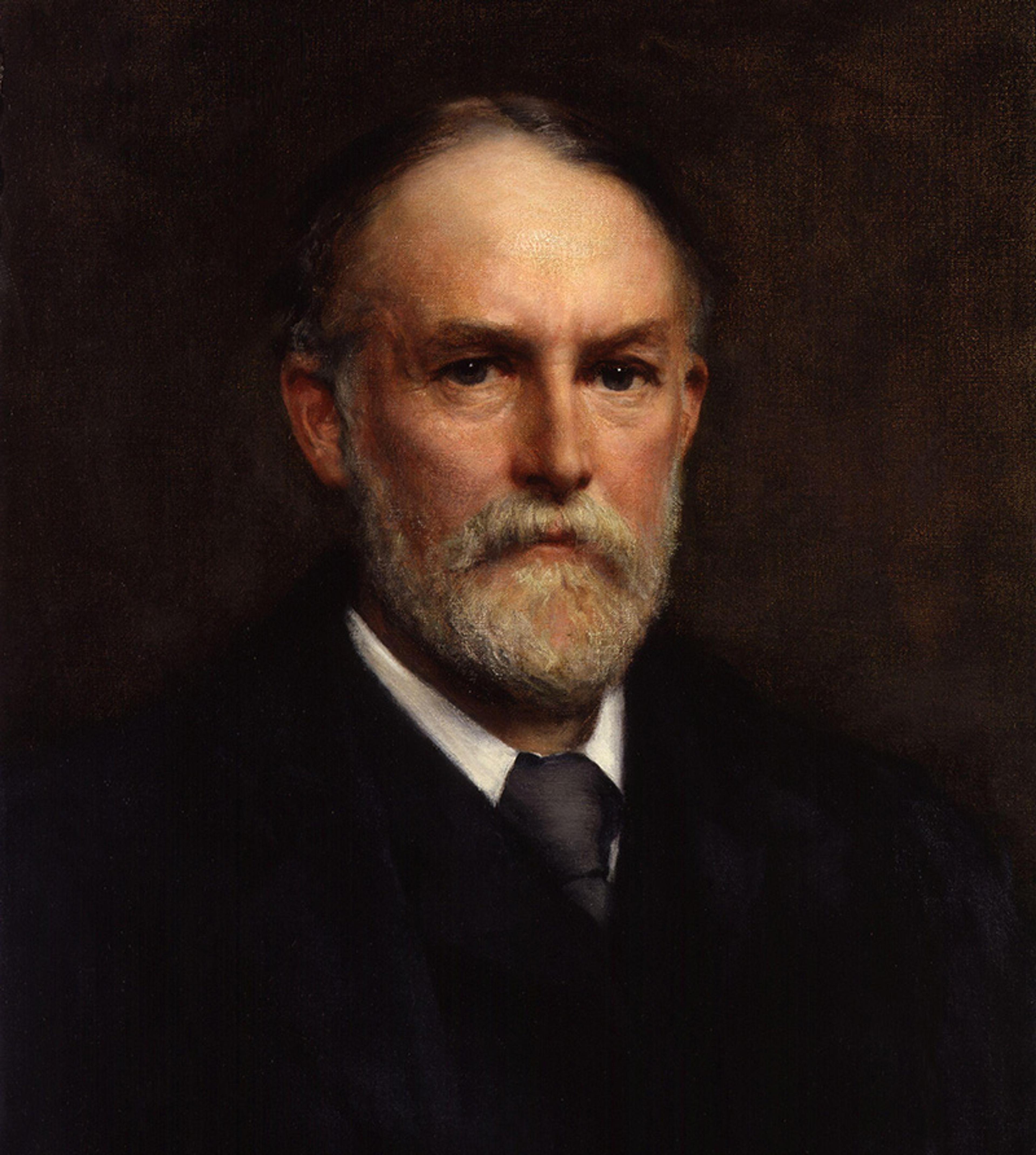
Portrait of Frederic Myers by William Clarke Wontner; unknown date. Courtesy the NPG London/Wikipedia
A series of personal crises in the 1870s, among them the suicide of his paramour Annie Eliza Marshall, prompted Myers to explore the déclassé world of spiritualist séances, involving so-called mediums (often women) who claimed that in trance states they became channels for messages from the dead, most famously rapped out on parlour tables, but also tooted through spirit trumpets, scrawled in automatic writing, spoken in direct voice, or even delivered by conjuring up the dead in ethereal form in the darkened séance room. For many people suffering religious doubt, the séance experience seemed to offer empirical proof of survival after death and, as such, was fervently embraced.
Spiritualism was both a mass movement and a folk religion, and it had some surprising support from men of science. The co-founder of evolutionary theory Alfred Russel Wallace became a passionate advocate, much to the annoyance of a sceptical Charles Darwin. The transatlantic telegraph engineer Cromwell Varley became a public convert, while leading physicists such as Oliver Lodge and Lord Rayleigh were open to it and sympathetic. Yet, because of the constant association of spiritualism with claims of fraud, involving cheaply staged magic tricks and simple-minded credulity, Myers did not publicly announce his own research...
more...
https://aeon.co/essays/for-over-a-century-telepathy-has-been-just-around-the-corner
F. Kaskais Web Guru


No comments:
Post a Comment