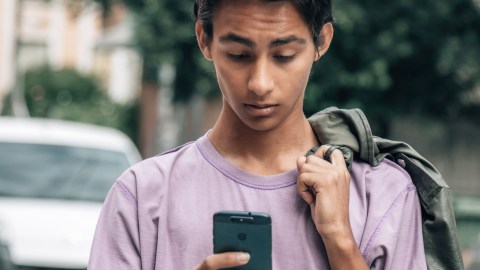
Credit: Tetxu / Adobe Stock
Everyone has to learn about sex somehow. Today, billions of people are learning about it from porn.
Key Takeaways
- The internet has changed almost all aspects of our life, but it's changed porn beyond recognition.
- To unpack the philosophy of porn, Big Think talked with Robert Jensen, emeritus professor at the University of Texas, and Dr. Matthew Ezzell, professor of sociology at James Madison University.
- Jensen and Ezzell argue that porn has changed our wider attitudes to sex and that porn is, in the main, toxic, exploitative, and damaging to most parties involved.
By Jonny Thomson
Imagine Simon — an archetypally horny teenager — trying to get his hands on porn throughout the ages. In the ancient world, he wouldn't find much besides some dodgy graffiti on the walls of the Colosseum and some childish doodles scratched into the cliffside. Sure, rich families might have commissioned a work or two, and holy families might have some bawdy marginalia. But there's not much.
In the 15th century, the printing press made porn more available but not ubiquitous — it was illegal in most countries and the erotic art you could find was mostly vanilla. The 20th century made things easier for Simon, ushering in readily available magazines and movies. Now, Simon knows where his dad keeps his magazines, and he knows a place across town where they're loose when checking IDs.
The 21st century now makes the previous one seem prudish. With his smartphone, Simon is on PornHub every day, thumbing through the fetishes and niches of the pornographic web, seeing things even his dad didn't know were possible — things Simon never really wanted to see.
The internet and pornography go hand in hand. The moment a new app, website, or technology is invented, it's usually only a few hours before someone somewhere tries to use it for porn. The online porn industry is worth more than Netflix, Hollywood, and Viacom. Just under 6 billion people access Pornhub every month. The internet has changed porn. And, arguably, porn has changed society.
Porn is a huge aspect of everyday people's lives and so it's no surprise that it's the subject of much discussion. It might not be timetabled at your local high school, but philosophy departments all over the world unpack what porn is and what it does. To get a small flavor of these philosophical discussions, Big Think spoke with two philosophers of porn: Robert Jensen, emeritus professor at the University of Texas, and Dr. Matthew Ezzell, professor of sociology at James Madison University.
The sexual norms of pornography
There is a story — albeit an apocryphal one — that the art critic John Ruskin was so repulsed by his wife's pubic hair on their wedding night that he couldn't consummate the marriage. Ruskin's knowledge of the female body had been entirely defined by classical statues and paintings, so when it came to seeing an actual naked woman, he was shocked.
The Ruskin myth is so enduring because it highlights the fact that we all have to be educated about sex somehow. Our parents might hold an awkward "birds and the bees" conversation. Or our schools may have a sex-ed class, though these are usually a sanitized, textbook version of sex that hides behind euphemisms and prudishly self-censors. Other times, people learn about sex from their peers — in giggling whispers or with bragging or strutting exaggeration. In reality, most people actually learn about sex by having sex.
The internet changed that. Now, almost anyone with an unlocked smartphone can access millions of videos about sex. Of course, the primary intention is an erotic one, but the secondary and unconscious one is pedagogical. A porn video is arousing, but it's also educational. It's telling the virginal and inexperienced that this is what sex is like. This is what proper sex is like.
As Ezzell puts it: "Media matter. They are a powerful force for learning and for the delivery of hegemonic ideologies. Sexualized media are arguably particularly powerful as agents of socialization and enculturation because they are so often consumed to facilitate masturbation. Social learning theory argues that media can provide heuristic scripts that help guide meaning-making and decision-making. That process is made stronger in the absence of compelling alternative scripts. In short, pornography will rush to fill the void, becoming the primary form of sex education for young people."
The Triple-A engine of porn
Before the 1990s, porn was available, but it usually had gatekeepers and was far more limited. The porn of the 2000s differed in three important ways — what some researchers call "the Three As" of anonymity, accessibility, and affordability. It's easy and free to watch porn, and no one will know you're doing so. As Jensen explains:
"There is the triple-A engine of the internet. First, anonymity. You can go online and you can view not only sexually explicit material but this very hard-core degrading material without ever revealing yourself in public. You don't have to go to a movie theater. You don't have to go to a magazine store. Second, affordability. It's increasingly cheap, and a lot of young people never bother paying for pornography online. There are so many free options...
more...
https://bigthink.com/thinking/the-triple-a-engine-how-the-internet-changed-porn-and-how-porn-changed-us/
F. Kaskais Web Guru


No comments:
Post a Comment